

26 Jan PFAS Explained: Why Now and What Comes Next
What is PFAS?
Per- and polyfluoroalkyl substances (PFAS), often called “forever chemicals”, are now among the most pressing environmental and public health challenges in the United States. Since the 1940s, PFAS have been used in thousands of everyday consumer and industrial products. Because they resist natural breakdown, they accumulate in water, soil, wildlife, and people, creating widespread risks that communities, utilities, and industries can no longer ignore. Meeting new regulatory standards while protecting public trust requires proactive detection, treatment, and prevention strategies.
Why Now?
Regulations are tightening, liability risks are growing, and public awareness is high. Acting early means:
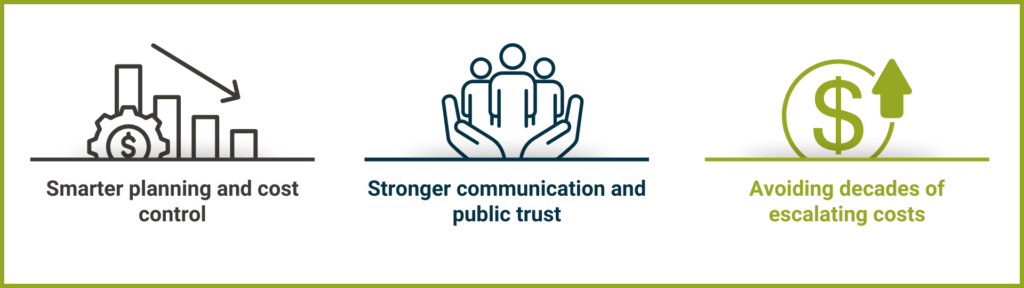
The cost gap is stark. PFAS themselves cost about $50 per pound, but cleanup can reach millions per pound removed. Prevention is far cheaper than remediation.
The PFAS Cycle
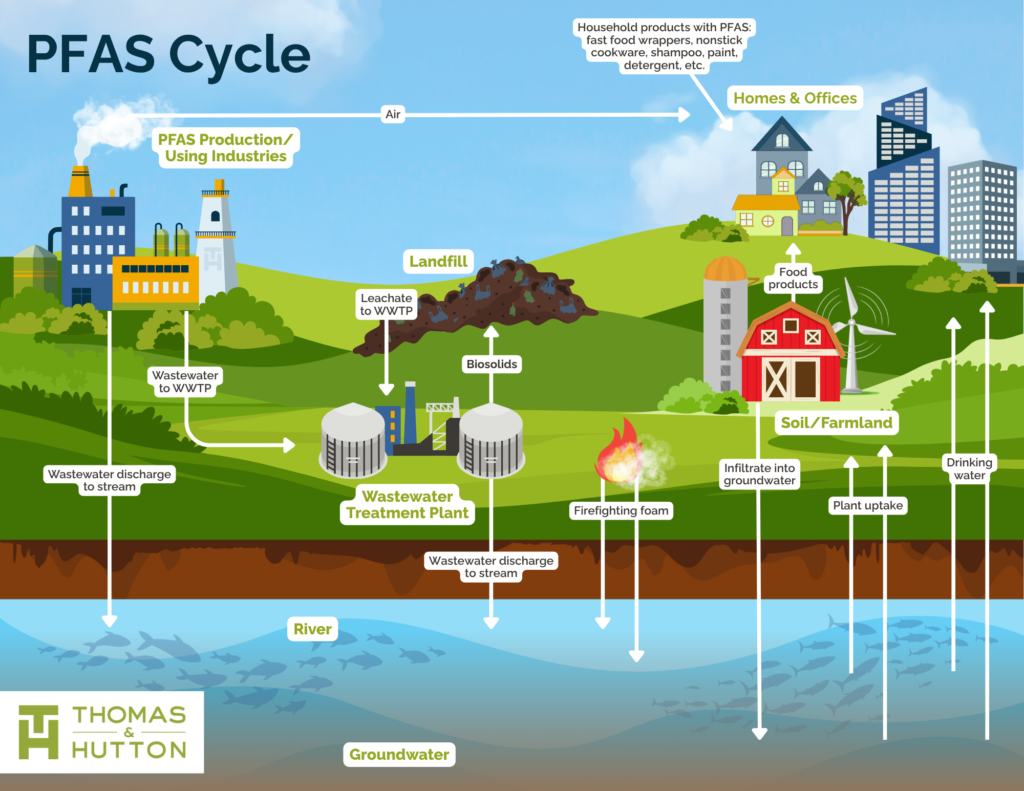
PFAS contamination follows a persistent and predictable path:
- Production & Use– Incorporated into cookware, textiles, food packaging, firefighting foams, and more.
- Release– Discharged into air, soil, and water during manufacturing, use, or disposal.
- Environmental Transport– Migrates through groundwater, surface water, and the food chain.
- Exposure & Impact– Consumed through drinking water, food, or air, with links to negative health effects.
PFAS: Widespread and Persistent
PFAS detections are now nationwide, with elevated concentrations often found near:
- Airports and military bases (firefighting foam applications)
- Industrial sites (chemical manufacturing, plating, textiles)
- Landfills and wastewater treatment plants (leaching and biosolids)
Once released, PFAS spread far beyond their source, impacting communities with no direct industrial connection.
By the Numbers (August, 2025)
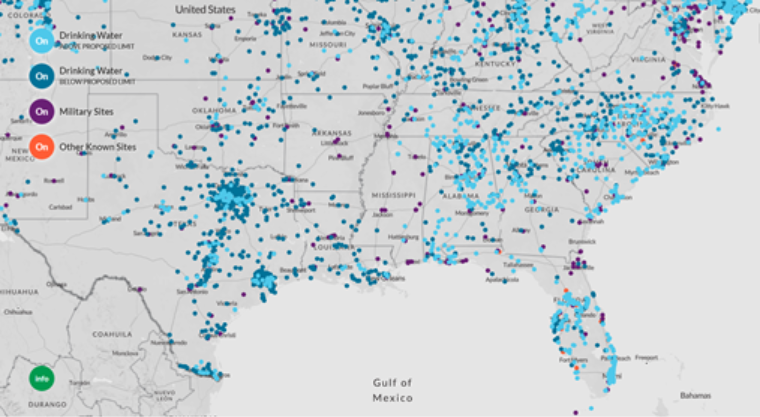
Environmental Working Group (EWG), Interactive Map: PFAS Contamination in the U.S. (August 14, 2025)
Communities across the country are confronting just how widespread and stubborn PFAS contamination has become. Recent data shows that roughly 8.5% of U.S. water systems exceed the new federal limits, a pattern mirrored in the light-blue clusters of samples on national monitoring maps. In the Southeast, the Carolinas, Georgia, Florida, Alabama, and Tennessee now require PFAS monitoring or reporting, revealing the scope more clearly than ever. North Carolina’s April 2024 findings alone identified more than 300 public systems above the new standards, including 42 municipal systems that collectively serve about three million people—underscoring the scale and persistence of the issue.
States Take the Lead on PFAS: Going Beyond Federal Rules
The federal government may have finally drawn its line on PFAS regulation, but across the Southeast, states are already stepping over it. In communities where “forever chemicals” have touched drinking water, farmland, and waterways, state leaders are crafting their own playbooks to fill the gaps and move faster than Washington.
From North Carolina’s tough groundwater limits to Georgia’s measured compliance deadlines, the message is clear- PFAS oversight is no longer a one-size-fits-all issue.
- North Carolinahas emerged as a testing ground for aggressive PFAS enforcement. The state has established groundwater limits (IMACs) for eight PFAS compounds and is crafting new rules for discharge sources. Its landmark Chemours Consent Order — born out of the contamination along the Cape Fear River — remains a national model for corporate accountability.
- South Carolinais, for now, in step with federal standards. But new legislation on the horizon could soon restrict PFAS discharges altogether, signaling a shift toward more protective measures.
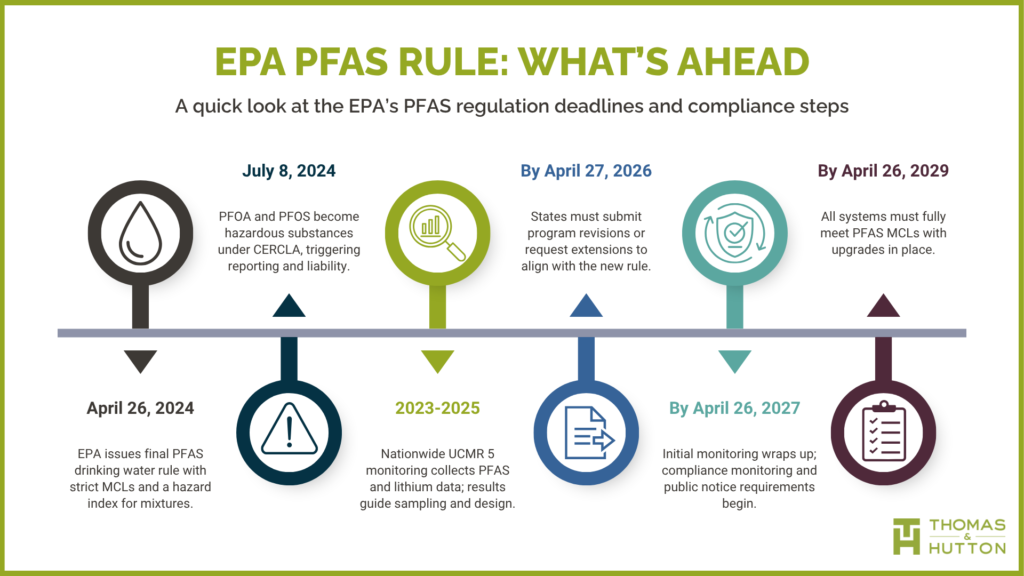
- Georgiais taking a long-view approach. The state plans to tie its Land Application System (LAS) compliance to new state drinking water limits, with quarterly monitoring starting in 2025 and full compliance by 2029. Georgia has also curbed the use of firefighting foams containing PFAS in training and testing exercises. Georgia’s EPD has proposed regulating two types of PFAS “forever chemicals” in drinking water. This follows a Trump Administration EPA decision to regulate only two PFAS types, down from the six finalized under the Biden Administration. Water systems will be required to monitor for PFOA and PFOS by 2027.
- Floridais in a holding pattern, using provisional cleanup levels while its Department of Environmental Protection refines new guidance.
- Alabamaset a major precedent through its consent order with 3M, which outlines cleanup responsibilities and paves the way for case-by-case permit scrutiny near known PFAS sources.
- Tennesseeis casting a wide net, rolling out a comprehensive sampling program that aligns with federal timelines and benefits from federal funding support.
What It Means on the Ground
For industries, utilities, and communities across these states, the evolving rules bring both uncertainty and opportunity. The takeaway? Don’t wait for Washington – action is already happening locally.
- In North Carolina, facilities may soon face mandatory pretreatment or cleanup tied directly to the state’s groundwater limits.
- South Carolinaoperators should prepare for new discharge restrictions if pending legislation becomes law.
- Georgia’sutilities would be wise to begin tracking PFAS sources and influent now – the groundwork laid today will make compliance far easier tomorrow.
- Florida’supcoming DEP update could mean that even sites currently meeting federal thresholds will need additional cleanup.
- Alabama’sregulators are signaling tighter oversight near industrial PFAS sources.
- Tennessee, meanwhile, is investing in broad testing and data collection to understand the scope of the problem before federal deadlines hit.
As the science evolves and the regulations follow, the Southeast is proving that environmental leadership doesn’t always start in Washington – sometimes, it starts with the states willing to go first.
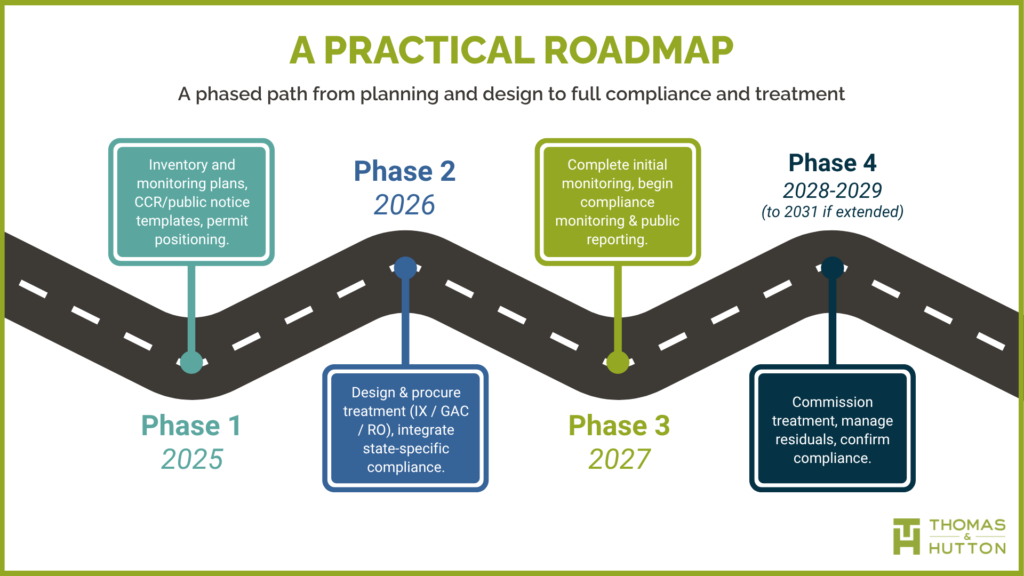
The Roadmap: From Planning to Compliance
Meeting these challenges requires a practical, phased approach – from assessment and design to full treatment and compliance. Thomas & Hutton helps utilities and industries chart a path that balances regulatory requirements, technical feasibility, and long-term resilience.
The Bottom Line
PFAS require more than technical fixes – they demand practical, real-world solutions tailored to each community and utility.
At Thomas & Hutton, we are ready to help you detect, treat, and prevent PFAS contamination – protecting safe water today and building resilient infrastructure for tomorrow.
Let’s plan your PFAS strategy today – https://www.thomasandhutton.com/pfas-emerging-contaminants/
